
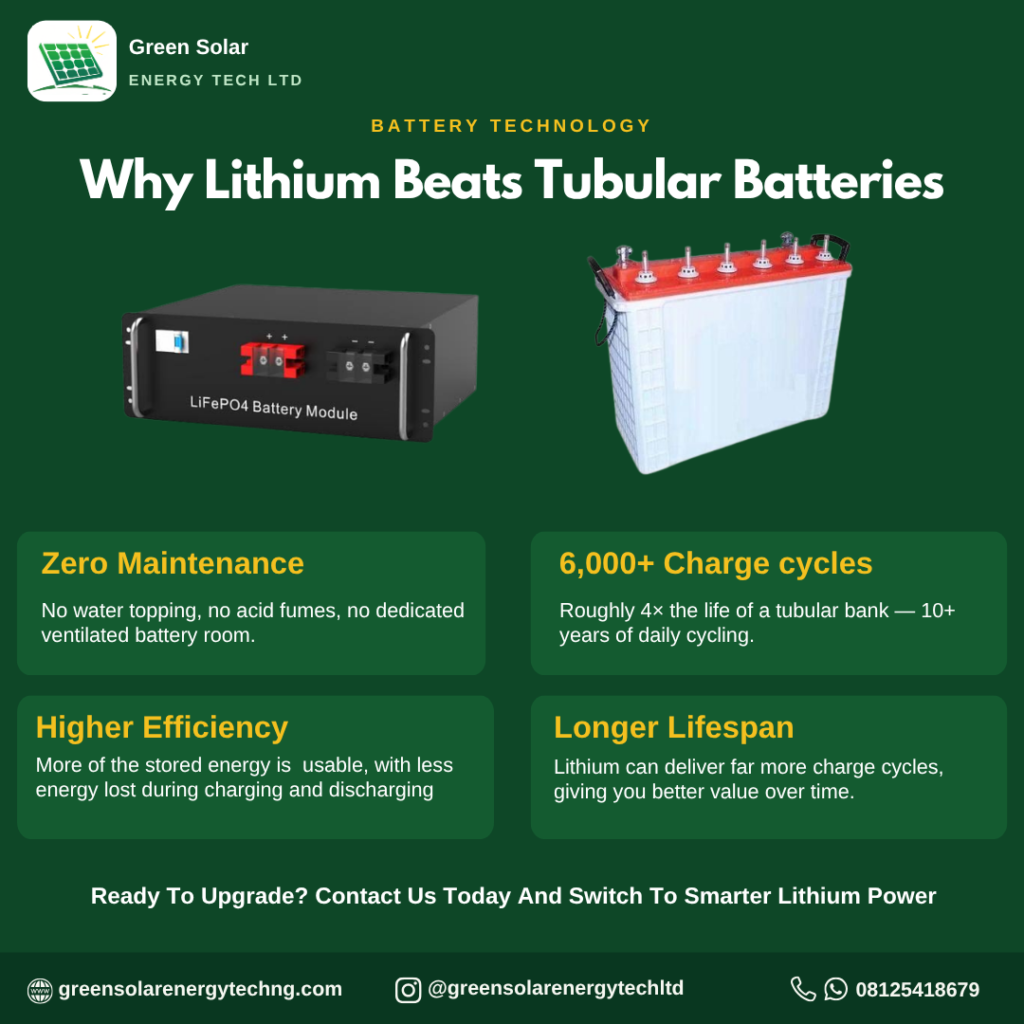
Verdict at a glance
- Lithium-ion batteries deliver a superior round-trip efficiency of 92 to 98 percent compared to the 80 to 85 percent efficiency of lead-acid options.
- The usable capacity of lithium-ion batteries spans 80 to 100 percent depth of discharge, whereas lead-acid batteries are limited to 30 to 50 percent.
- Lithium-ion batteries generally last 8 to 15 years, while traditional lead-acid batteries typically require replacement after 2 to 4 years.
- Lithium-ion batteries are significantly lighter, weighing 22 to 33 pounds per kilowatt-hour compared to 45 to 65 pounds for lead-acid.
- Safety standards such as NFPA 855 permit residential energy storage systems between 1 and 20 kilowatt-hours in garages but restrict habitable room installations.
1. Round-trip efficiency: how much solar power do you actually keep?
Lithium battery vs lead-acid battery for solar is a critical comparison because round-trip efficiency determines how much of your generated solar power is actually preserved for your home or business. Lithium-ion batteries operate with a high round-trip efficiency of 92 to 98 percent, ensuring minimal energy loss during charging and discharging cycles. In contrast, traditional lead-acid batteries lose a significant portion of generated solar energy, operating at a lower efficiency of 80 to 85 percent, according to data published by electricaltrader.com.
This performance gap directly impacts the daily utility of your solar power system. When solar panels generate electricity, a deep cycle lead-acid battery dissipates up to one-fifth of that energy as heat during storage and retrieval. Lithium solar batteries for home use preserve almost all captured energy, allowing homes, businesses, and institutions to maximize their solar panel investment and secure true energy independence.
| Battery Technology | Round-Trip Efficiency | Usable Capacity (Depth of Discharge) | Primary Benefit |
|---|---|---|---|
| Lithium-ion | 92% to 98% | 80% to 100% | Maximum energy retention and deeper daily usage |
| Lead-acid | 80% to 85% | 30% to 50% | Lower initial acquisition cost for basic backup |
Choosing highly efficient battery storage helps property owners avoid wasting precious solar generation. By minimizing conversion losses, highly efficient systems ensure that the power captured during the day is fully available to run appliances quietly and sustainably through the night.
2. Usable capacity: how deep can you safely drain your battery bank?
The usable capacity of a solar battery is determined by its safe depth of discharge, which dictates how much stored energy can be drawn before recharging is required to prevent cell damage. For residential energy storage systems, this metric directly impacts the physical footprint and long-term value of the installation.
A comparison of how these two technologies perform under daily operational demands reveals distinct differences in efficiency and lifespan:
| Battery Technology | Composition | Usable Capacity (DoD) | Round-Trip Efficiency | Lifespan (Cycles) |
|---|---|---|---|---|
| Lithium Iron Phosphate | Lithium iron phosphate cells | 80% to 100% | 92% to 98% | 3,000 to 10,000 cycles |
| Deep Cycle Lead-Acid | Lead-plates in sulfuric acid | 30% to 50% | 80% to 85% | 400 to 1,200 cycles |
Lithium solar batteries for home use allow a depth of discharge between 80 and 100 percent, letting home solar installations utilize almost all stored energy without damaging the cells. According to technical data published by electricaltrader.com, a deep cycle lead-acid battery suffers rapid degradation if discharged past 30 to 50 percent of its total capacity. This limitation means a lead-acid system requires a much larger physical bank to deliver the same usable energy as a compact lithium setup.
Understanding depth of discharge is critical for sizing a home solar installation to ensure continuous operations during extended grid outages. Relying on lithium iron phosphate chemistry provides a battery round-trip efficiency of up to 98 percent, ensuring minimal power loss during the conversion process. This high efficiency, combined with a solar battery lifespan of up to 15 years, makes modern lithium technology a reliable choice for achieving true energy independence.
3. Lifespan and durability: which technology survives hot climates longer?
Lithium solar batteries for home use deliver a lifespan of 8 to 15 years, operating reliably for 3,000 to 10,000 cycles before capacity drops significantly. In contrast, a deep cycle lead-acid battery offers a brief operational lifespan of 2 to 4 years, translating to only 400 to 1,200 cycles under normal conditions. This difference in durability becomes even more pronounced in hot climates, where elevated temperatures accelerate the chemical degradation of battery cells.
According to a technical comparison by electricaltrader.com, the chemical composition of lithium technology is far more resilient to thermal stress than traditional lead-acid chemistry. High ambient temperatures cause the water in lead-acid electrolytes to evaporate, leading to rapid plate corrosion and premature system failure. Investing in durable lithium technology solves the power problem long-term by eliminating the frequent replacement costs of lead-acid cells.
| Battery Technology | Expected Lifespan | Cycle Life Range | Usable Capacity (DoD) | Temperature Resilience |
|---|---|---|---|---|
| Lithium-ion | 8 to 15 years | 3,000 to 10,000 cycles | 80% to 100% | High resilience to thermal degradation |
| Lead-acid | 2 to 4 years | 400 to 1,200 cycles | 30% to 50% | Poor resilience, high heat accelerates failure |
For residential energy storage systems, choosing lithium iron phosphate safety and stability means the energy storage system continues to perform year after year without constant maintenance. While a lead-acid bank requires replacement multiple times over a decade, a single lithium installation provides continuous, worry-free power. This long-term durability ensures that homes and businesses secure a proven return on investment while enjoying true energy independence.
4. Physical weight and footprint: where will your energy storage sit?
The physical size and weight of a solar battery determine where it can be installed and how much structural reinforcement the property requires. Choosing between these technologies is not just a matter of electrical capacity, it is a practical spatial decision for any home or business.
Lithium-ion batteries offer a highly compact, lightweight energy storage solution. According to technical data published by electricaltrader.com, lithium-ion batteries weigh between 22 and 33 pounds per kilowatt-hour. This low physical density allows for flexible installation options, including wall mounting in tight utility closets or residential spaces.
In contrast, deep cycle lead-acid battery banks require substantial physical space and heavy structural support. These systems weigh between 45 and 65 pounds per kilowatt-hour, making them more than twice as heavy as lithium alternatives for the same amount of stored energy. This extreme weight means lead-acid setups must sit on reinforced concrete floors, and they cannot be mounted on standard residential walls.
| Battery Type | Physical Weight (per kWh) | Installation Flexibility | Space Requirement |
|---|---|---|---|
| Lithium-ion | 22 to 33 pounds | High (wall-mountable, compact indoor spaces) | Minimal footprint |
| Lead-acid | 45 to 65 pounds | Low (floor-standing only, requires reinforced surfaces) | Large dedicated footprint |
For properties with limited square footage, lithium solar batteries for home use provide the necessary power without consuming valuable living or operational space. When planning a residential energy storage system, the physical footprint must comply with local safety guidelines.
For example, the National Fire Protection Association standard NFPA 855 permits stationary energy storage systems between 1 kWh and 20 kWh to be installed in attached or detached garages, but strictly prohibits placing them in habitable rooms, roof spaces, or wall cavities. Selecting a compact lithium iron phosphate battery makes it much easier to meet these strict spatial and safety placement rules.
5. Safety standards and installation rules: are you meeting NFPA 855 guidelines?
- Understand the NFPA 855 standard
The NFPA 855 standard regulates the installation of stationary energy storage systems to mitigate thermal runaway and fire propagation risks. This standard is crucial for ensuring the safety of lithium solar batteries for home use, which have higher energy densities than traditional deep cycle lead-acid battery options.
- Know the residential capacity limits
For residential properties, the NFPA 855 standard permits energy storage systems with a usable capacity depth of discharge between 1 and 20 kilowatt-hours. These systems can be safely installed in attached or detached garages, providing a secure environment that manages potential thermal risks.
- Avoid prohibited installation zones
To protect household safety, installation is strictly prohibited in habitable rooms, roof spaces, wall cavities, or directly under staircases. Following these spacing and location rules is a vital part of any home solar installation guide and tips.
- Select certified battery technologies
Choosing lithium iron phosphate safety certified batteries helps meet these rigorous standards. While lithium-ion batteries generally offer a superior solar battery lifespan cycles of 3,000 to 10,000 cycles compared to the 400 to 1,200 cycles of lead-acid options, they must be installed according to local building codes and NFPA guidelines to ensure long-term operational safety.
6. Lithium iron phosphate vs alternative chemistries: why does LiFePO4 lead?
Lithium Iron Phosphate, commonly known as LiFePO4, represents the premier standard for residential solar storage due to its exceptional thermal and chemical stability. When evaluating options for home energy storage systems, safety and longevity remain the primary criteria for securing true energy independence.
Unlike alternative lithium chemistries, such as Lithium Nickel Manganese Cobalt Oxide (NMC), LiFePO4 offers superior resistance to thermal runaway. This chemical resilience makes the technology highly secure for indoor and garage installations, aligning with the safety guidelines of NFPA 855 for residential energy storage systems. While other chemistries risk combustion under extreme heat, LiFePO4 remains stable under variable grid conditions and high ambient temperatures.
This chemistry delivers an outstanding solar battery lifespan of 3,000 to 10,000 cycles, representing a service life of 8 to 15 years. Combined with a high battery round-trip efficiency of 92% to 98%, this technology ensures that the noisy, expensive generator is a relic of the past, allowing households to run freely, quietly, and sustainably.
| Battery Technology | Chemical Composition | Primary Application | Key Differentiator | Optimal Choice |
|---|---|---|---|---|
| LiFePO4 | Lithium Iron Phosphate | Residential solar storage | High thermal stability and long cycle life | Maximum safety and long-term return on investment |
| NMC | Lithium Nickel Manganese Cobalt | Portable electronics and electric vehicles | High energy density in a compact footprint | Space-constrained applications where weight is critical |
| Lead-Acid | Lead and Sulfuric Acid | Backup power and starting batteries | Low initial acquisition cost | Budget-constrained installations with low daily cycling needs |
Choosing LiFePO4 ensures that home solar installations operate with maximum usable capacity and depth of discharge without cutting corners on quality.
7. Lead-acid vs lithium-ion: when does the older technology make sense?
Deep cycle lead-acid battery technology remains a practical choice for specific, low-demand energy setups where minimizing upfront capital is the primary goal. While lithium solar batteries for home use offer superior long-term efficiency, the older technology serves as a functional alternative for systems that do not require daily, intensive cycling.
According to a technical comparison by electricaltrader.com, lead-acid options operate at 80 percent to 85 percent round-trip efficiency, compared to the 92 percent to 98 percent efficiency of lithium-ion systems. This difference makes lead-acid less suitable for heavy daily residential use, but highly viable for occasional applications.
| Battery Technology | Primary Application | Usable Capacity (DoD) | Lifespan (Cycles) | Best Suited For |
|---|---|---|---|---|
| Lead-Acid | Backup power | 30% to 50% | 400 to 1,200 | Seasonal cabins and low-budget backup |
| Lithium-Ion | Daily cycling | 80% to 100% | 3,000 to 10,000 | True energy independence for homes |
Unattended backup stations, seasonal cabins, or emergency backup systems that only require occasional power can utilize lead-acid chemistry without experiencing rapid degradation. Because these installations do not undergo deep daily discharges, the lower usable capacity depth of discharge of 30 percent to 50 percent is not a severe limitation.
For daily residential energy storage systems, lithium iron phosphate safety and high cycle life make lithium the standard choice to avoid frequent maintenance and replacement. Homeowners seeking to eliminate generator dependency permanently can consult a home solar installation guide and tips to plan a transition to high-efficiency lithium storage.
FAQ
How does a lithium solar battery compare to a traditional deep cycle lead-acid battery for daily home use?
Lithium solar batteries outperform traditional deep cycle lead-acid batteries by offering up to double the usable capacity and lasting up to four times longer. They operate at 92 to 98 percent efficiency, meaning you waste far less solar power during daily charge cycles.
What is the primary decision criterion when choosing between these two battery types?
The primary decision criterion is the total cost of ownership over time rather than the upfront price. While lead-acid is more affordable initially, lithium’s long lifespan of 8 to 15 years and high depth of discharge make it far more cost-effective over its lifetime.
When should a homeowner avoid installing a standard lithium solar battery system?
A homeowner should avoid installing a standard lithium battery if they cannot place it in an approved location under NFPA 855 guidelines, such as a garage or dedicated exterior enclosure. It must never be installed in habitable rooms, roof spaces, or under staircases.
What is the main failure mode for lead-acid batteries in solar setups?
The main failure mode for lead-acid batteries is chronic undercharging, which leads to sulfation on the lead plates. This occurs when the battery is repeatedly discharged past its recommended 50 percent limit or left uncharged, permanently destroying its capacity.