
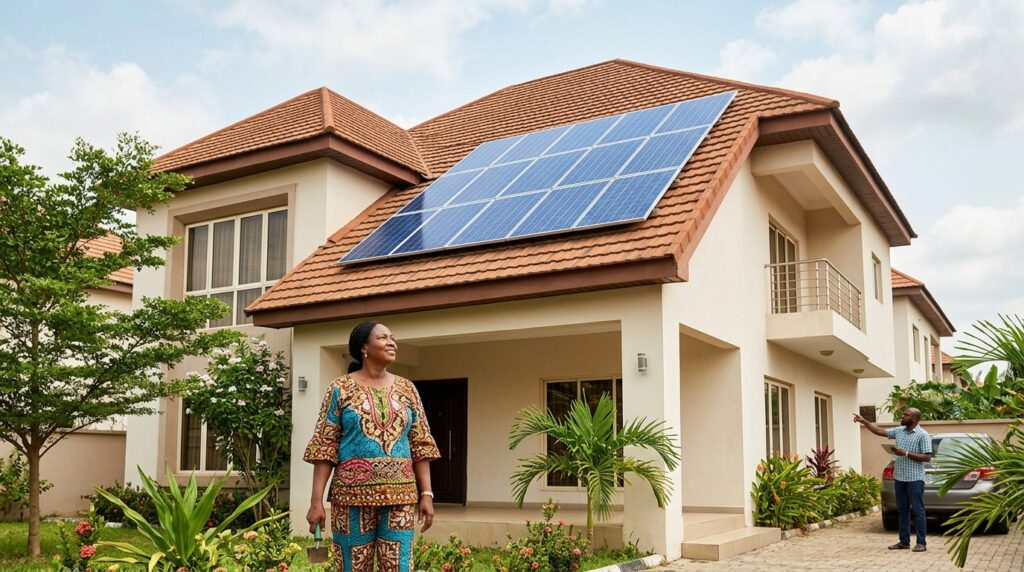
Calculate your household energy consumption: the path to lower bills
To reduce electricity bills with solar, a household must first establish a precise baseline of its daily energy consumption. Transitioning to a solar power system allows Nigerian homes to decrease reliance on the national grid and eliminate the high costs associated with diesel generators. According to data published on osgf.gov.ng, managing energy infrastructure remains a key focus of national development policies, making household self-generation a highly practical path to long-term savings. Determining your load requirements involves a systematic three-step process:
- Identify daily appliance wattage: List the power ratings of all essential appliances, such as lighting, refrigeration, and cooling systems. Multiply the wattage of each device by the number of hours it runs daily to calculate the watt-hours required.
- Calculate monthly kilowatt-hours: Aggregate the daily watt-hours of all appliances and divide by 1,000 to convert the figure into kilowatt-hours. Multiply this daily total by 30 to establish your monthly consumption baseline, which is critical for custom solar system design.
- Estimate system size online: Use the official online tool to quickly estimate your specific household load requirements and system size. You can access the professional solar calculator here to receive an immediate estimate tailored to your home.
When planning the system, the choice of battery technology directly impacts long-term efficiency. Lithium-ion batteries are highly recommended over traditional lead-acid options because they deliver a superior round-trip efficiency of 92 to 98 percent. These advanced batteries also provide a greater usable capacity, operating at an 80 to 100 percent depth of discharge, and offer a lifespan of 8 to 15 years to secure your investment.
Is our online calculator the fastest way to estimate your solar needs?
Manual calculations for solar sizing often lead to errors, over-designed systems, or under-powered setups that fail during variable grid conditions. Using the Green Solar Energy Tech Limited interactive calculator bypasses complex manual math entirely, providing a precise starting point for your transition to emission-free power. By inputting your average monthly utility costs or a basic list of household appliances, you receive an instant, tailored system capacity recommendation.
Planning a solar transition requires accurate load profiling to ensure your system runs freely, quietly, and sustainably without cutting corners on quality.
These calculated metrics allow Nigerian households to plan their energy independence effectively, serving as a reliable alternative to grid power outages. Instead of relying on noisy, expensive generators, you can use these precise capacity requirements to select the exact solar package tier that fits your daily consumption. To get an immediate, accurate estimate for your home or business, access the official tool directly at GSET Solar Calculator.
Select the right battery technology: lithium-ion versus lead-acid

Selecting the right battery technology is the most critical decision when designing a solar system installation for a 4 bedroom duplex or any household seeking alternatives to grid power outages. The storage system determines how much of your generated power is preserved for nighttime use and how many years the system operates before requiring expensive replacements. For Nigerian households, the choice comes down to traditional lead-acid deep-cycle batteries or modern lithium-ion chemistry.
Lithium-ion batteries for home solar offer superior technical performance across every operational metric. A primary advantage is round-trip efficiency, which ranges from 92% to 98% for lithium-ion systems, ensuring that minimal solar energy is wasted during the charge and discharge cycle. In contrast, lead-acid options lose significantly more energy as heat, typically operating at only 80% to 85% efficiency.
The usable capacity of these technologies also differs greatly. Lithium-ion chemistry allows for a depth of discharge between 80% and 100% without damaging the internal cells, meaning you can use almost all the power stored inside. Lead-acid batteries should not be discharged past 50% of their capacity if you want to prevent premature failure. This means a lead-acid bank must be twice the physical size of a lithium-ion bank to deliver the same usable daily electricity.
| Feature | Lithium-Ion Batteries | Lead-Acid Batteries |
|---|---|---|
| Composition | Lithium iron phosphate or nickel manganese cobalt | Liquid flooded, sealed gel, or absorbed glass mat |
| Primary purpose | Daily cycling for energy independence | Backup power or daily cycling |
| Depth of discharge | 80% to 100% usable capacity | 50% maximum recommended discharge |
| Round-trip efficiency | 92% to 98% efficiency | 80% to 85% efficiency |
| Expected lifespan | 8 to 15 years in Nigerian conditions | 2 to 5 years with careful maintenance |
| Best application | Daily cycling to reduce electricity bills with solar | Budget-constrained systems with low daily usage or other needs |
While the initial investment for lithium-ion technology is higher, the long-term lifespan delivers reliable service for 8 to 15 years in Nigerian conditions. Lead-acid batteries typically require replacement every 2 to 5 years, especially when subjected to the high ambient temperatures common in Nigeria. Over a ten-year period, a single lithium-ion bank outlasts multiple lead-acid replacements, making it the more cost-effective choice for securing reliable solar power for Nigerian households.
To find the exact battery capacity and system configuration required to eliminate generator noise and grid outages in your home, you can use the interactive Green Solar Energy Tech Limited calculator Click here
Plan a solar system installation for a 4 bedroom duplex: sizing the load
Planning a solar system installation for a 4 bedroom duplex requires a precise assessment of your daily energy consumption to ensure continuous power without system overload.
Before beginning your transition to clean, reliable solar energy, you must verify that your property has sufficient, unshaded roof space and the structural integrity required to support high-efficiency solar photovoltaic panels. Heavy-load appliances, particularly air conditioning units and water pumping machines, must be fully accounted for in your daily load profile to prevent system failure.
To design a system that perfectly balances your specific budget, geographic location, and daily load profile, you should consult certified engineers who can customize the installation. You can easily estimate your initial capacity needs by using the online calculator tool here. To prepare for your installation, complete the following checklist:
- Confirm that the roof structure can support the weight of the solar photovoltaic array.
- Map out all high-surge appliances, including air conditioners and pumping machines, to determine the required inverter capacity.
- Document your average monthly utility bills to establish your baseline energy consumption.
- Schedule a professional site assessment with certified engineers to evaluate shading and roof orientation.
Once you have completed these verification steps, you are ready to proceed with a custom system design.
Partner with certified engineering experts: securing your investment
Securing a reliable solar system installation for a 4 bedroom duplex or any modern home requires precise engineering rather than generic electrical work. Working with Green Solar Energy Tech Limited provides access to professional installation and support for your custom-engineered solar power system. Certified technical teams perform comprehensive site assessments to calculate exact load requirements, preventing the system overloads that commonly lead to premature component failure.
Professional installation guarantees optimal panel orientation to maximize daily sun exposure under local weather patterns. Expert technicians handle wiring configurations to support system installation, helping to manage electrical requirements and ensuring that lithium-ion batteries for home solar are installed according to professional standards. This meticulous approach to custom solar system design protects your equipment and ensures your household can safely reduce electricity bills with solar power.
Establishing a direct support channel with our technicians provides long-term security for your energy investment. This local presence provides support for ongoing maintenance and professional installation services. To accurately determine the ideal system size and component specifications for your property, you can use the interactive tool here to plan your transition to clean, quiet, and reliable solar power.
Calculate your potential savings with our online solar tool
Transitioning to solar power requires a clear understanding of potential financial and energy savings before making an investment. Homeowners in Nigeria can easily determine their expected reduction in monthly electricity bills by inputting their current energy usage into an interactive estimator. This digital tool processes household consumption patterns to provide an immediate, customized projection of solar capacity requirements and long-term cost benefits.
FAQ
What primary factor determines whether a Nigerian home is ready for a solar installation?
The primary factor is the availability of unshaded roof space or ground area that can accommodate solar panels. Certified engineers must also assess the structural integrity of the roof and the existing electrical wiring of the home to ensure compatibility.
Why do residential solar systems experience premature battery bank degradation under hot climate conditions?
High ambient temperatures accelerate the internal chemical reactions in batteries, particularly traditional lead-acid types, leading to rapid water loss and grid corrosion. Utilizing lithium-ion batteries mitigates this risk due to their superior thermal tolerance and advanced battery management systems.
Is a standard residential solar setup suitable for a home requiring continuous power during extended grid outages?
Yes, a professionally designed system utilizing lithium-ion batteries with a 92% to 98% round-trip efficiency is highly suitable. It ensures that stored solar energy is efficiently dispatched to keep critical household appliances running seamlessly during prolonged utility failures.
When should a homeowner avoid installing a standard solar power system?
A homeowner should avoid a standard installation if the property has severe, unresolvable shading from adjacent buildings or trees, or if the roof structure is too weak to support the weight of the solar array without undergoing major structural repairs.